Article
The Bespoke Process
Written by Giada
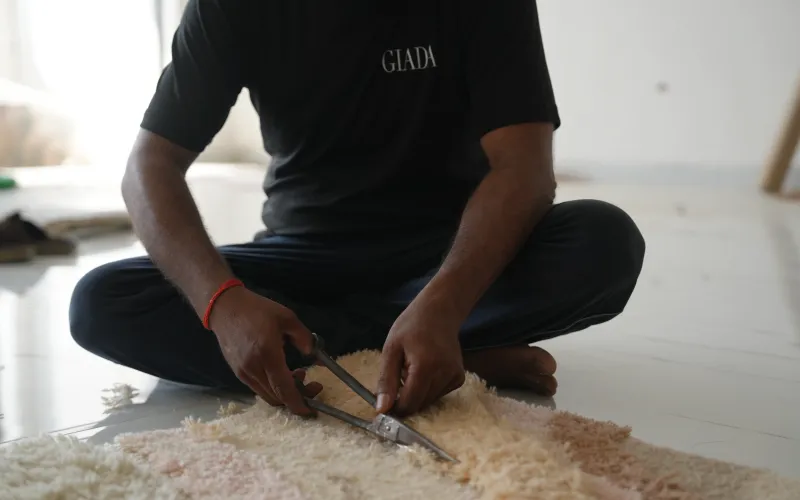
A bespoke rug does not begin on a loom. It begins with a conversation — often a tentative one, about a room that isn’t quite finished, a space that needs something to hold it together. What follows, over several weeks or months, is a process of translation: turning the way someone wants a room to feel into a physical object that lives in it.
The Brief
The first step is understanding the space. Dimensions, of course, but also light — how it enters the room, how it moves through the day, how it falls on the floor. Natural and artificial light behave differently on pile, and a color that reads as warm and neutral in afternoon sun can feel cold and grey under the wrong bulb.
We also ask about use. A rug in a primary living space lives differently than one in a private bedroom or a formal dining room. The difference shapes decisions about fiber, pile height, and construction that will affect how the piece performs over years of daily contact.
The Design
With a clear brief, design begins. For Giada’s custom work, this means developing a composition specific to the space — proportions, motifs, and palette considered together rather than assembled from existing stock. Early in this phase, we produce strike-offs: small-scale samples that show how a colorway reads in the actual pile construction, under the actual light of the room if possible.
Strike-offs are where assumptions are tested. A color that seemed right in a swatch often needs adjustment once it exists at pile height, with the sheen and shadow of real texture. This step matters — it is far easier to correct a direction here than to modify a finished piece.
Production
Once a design and colorway are approved, production begins. Lead times for hand-knotted work depend on the complexity and scale of the piece, but most bespoke rugs take several months from approval to completion. This is not a limitation — it is simply the nature of work done by hand, at the pace that quality requires.
When the rug arrives, it carries the record of that process: the hours, the hands, the specific decisions made along the way. That record is what makes a bespoke object different from a purchased one — not just in how it looks, but in what it is.