Article
The Art of Hand-Knotting
Written by Giada
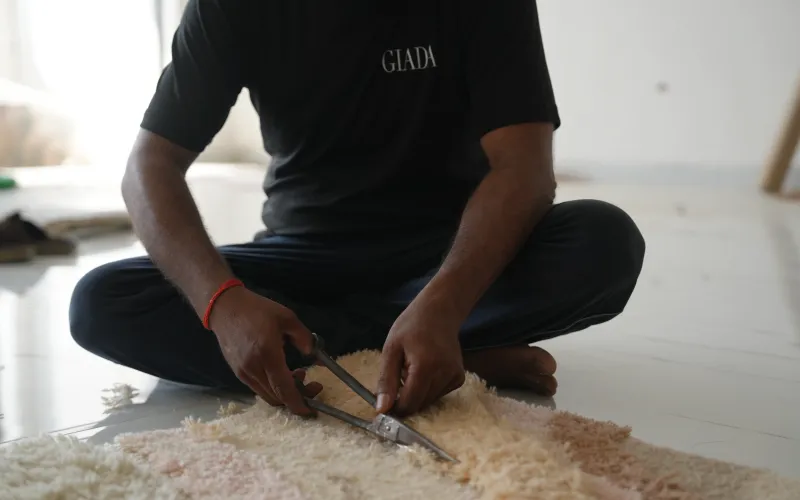
There is no shortcut to a hand-knotted rug. The process begins with raw fiber — wool, silk, or a blend — and ends only when the last knot has been tied, the pile sheared, and the surface washed and stretched flat. In between, weeks or months pass quietly, each hour adding perhaps a few inches of pattern to a growing field of texture.
A Knot at a Time
The foundation of a hand-knotted rug is the loom, a simple frame that holds the warp threads taut while the weaver works across them row by row. For each knot, a short length of yarn is looped around two warp threads and pulled tight. Thousands of these knots form a single square foot of pile. A room-sized rug may contain millions.
The knot count — measured per square inch — is one indicator of density and detail. Finer rugs, woven at higher counts, can render intricate motifs with almost painterly precision. Coarser constructions carry a different quality: a boldness of texture, a visible grain that rewards touch as much as sight.
Why It Matters
Machine-made rugs are pressed and cut to a consistent height. Hand-knotted rugs are not. The slight variation in pile, the subtle shifts in shading from one skein to the next, the faint traces of the weaver’s rhythm across the field — these are not flaws. They are evidence of process, and they give handmade textiles a quality of presence that manufactured goods cannot replicate.
At Giada, every piece begins with a conversation about space, light, and use. The knotting that follows is an act of translation — turning intention into texture, one careful row at a time.