Article
Natural Fibers: A Guide
Written by Giada
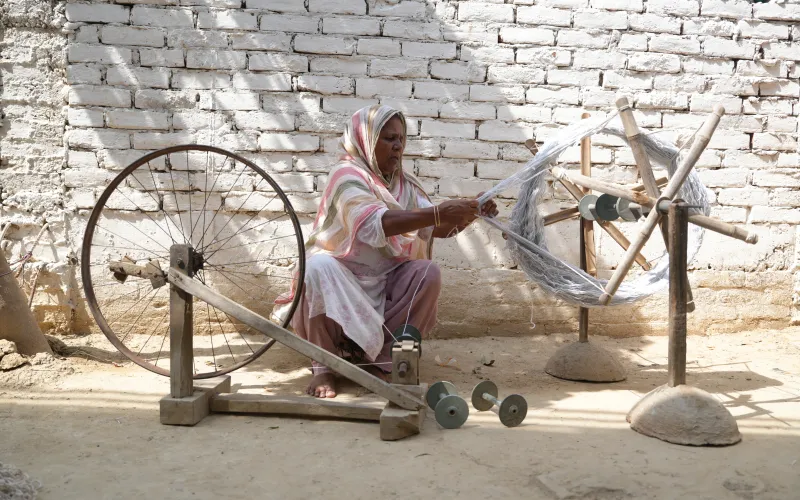
The material a rug is made from determines almost everything about it: how it feels underfoot, how it holds dye, how it responds to light, and how it changes with age and use. At Giada, material selection is one of the first decisions in any bespoke project — not a finishing detail, but a foundation.
Wool
Wool is the traditional rug fiber, and for good reason. It is naturally resilient: the crimp in each fiber creates a memory that allows the pile to recover from compression. It resists moisture and soil better than most synthetics, and it holds dye in a way that produces depth and richness rather than flatness.
Wool rugs age honestly. The pile softens and the colors develop a patina that makes them more interesting, not less. A well-made wool rug, properly cared for, can last generations — and often improves as it does.
Silk
Silk introduces luminosity. Because each fiber is essentially a fine prism, a silk rug shifts color as the viewing angle changes — a quality called luster that no other material replicates. This makes silk exceptional for detailed, figurative work: the light plays across the pile and gives the pattern a life that flat photography rarely captures.
Silk is delicate relative to wool. It is best suited to areas with moderate foot traffic, or used as an accent in high-pile constructions where it sits between wool knots and catches light without bearing the full weight of daily use.
Natural Plant Fibers
Jute, sisal, hemp, and seagrass offer texture and informality that wool and silk do not. They are coarser underfoot and less forgiving of spills, but they bring an organic quality — a kind of material honesty — that suits relaxed, natural interiors.
These fibers respond to humidity and temperature differently than protein fibers, which means they require some care in climate-controlled environments. But used appropriately, they add a tactile dimension that feels grounded and genuine.
Blends
Many of the most interesting rugs are made from combinations: wool and silk for a pile that is both durable and luminous; wool and hemp for structure and texture; silk highlights within a wool field that draw the eye without dominating it.
At Giada, we work with each fiber’s strengths rather than against its limitations — and we take time, at the start of every project, to understand which combination will serve the space and the client best.